
Reduce Crypto Payment Processing Fees: Merchant Discounts Are Live
Reduce crypto payment processing fees with xMoney Merchant Discounts. Stake XMN, lower settlement costs, and earn merchant rewards automatically.

For years, merchants have treated payment fees as a fixed cost of doing business.
Necessary, unavoidable, and ultimately disposable.
Money comes in, payouts get settled, fees get deducted, and the cycle repeats itself thousands of times without leaving anything behind except operational overhead.
That’s exactly the logic xMoney Merchant Rewards was designed to challenge.
A few weeks ago, we introduced the first layer of the program: a system where part of the settlement fees generated through merchant activity is automatically converted into XMN, creating a rewards balance that accumulates over time directly inside the merchant dashboard.
Now, xMoney is expanding that model with a second layer built around a different idea: what if merchants could also reduce the fees themselves?
Not through temporary campaigns or negotiated pricing tables, but through participation in the ecosystem they are already helping power.
That second layer is called Merchant Discounts.
How to Reduce Crypto Payment Processing Fees Without Changing Your Payment Flow
Traditional payment systems are fundamentally extractive.
The more volume a business processes, the more fees it generates for providers, processors, intermediaries, and banking infrastructure. Scale may improve operational efficiency, but rarely changes the relationship itself: merchants continue paying into systems they have no participation in.
The xMoney Rewards structure introduces a different dynamic.
The first part of the program, XMN Rewards, transforms a portion of settlement fees into assets that accumulate over time.
Merchant Discounts build on top of that by introducing a direct operational advantage tied to staking.
In practice, merchants who stake XMN reduce the settlement fees applied to their payouts automatically, without changing their existing payment flows or operational setup.
The more aligned a merchant becomes with the ecosystem, the more efficient the economics around those payments become.
Not because fees disappear entirely, but because participation starts affecting the structure behind them.
Crypto Merchant Rewards vs Merchant Discounts: What's the Difference?
Although both mechanisms sit under the xMoney Rewards umbrella, they solve different things.
XMN Rewards focus on accumulation.
Every payout processed through xMoney automatically converts a percentage of the settlement fee into XMN on behalf of the merchant. The percentage depends on rolling payment volume, allowing rewards to scale naturally alongside business growth.
Merchants processing larger volumes unlock progressively higher reward tiers, reaching up to 10% of xMoney’s settlement fee converted into XMN.
But Merchant Discounts operate from the opposite direction.
Instead of generating additional value after fees are applied, staking reduces the fee itself before settlement happens.
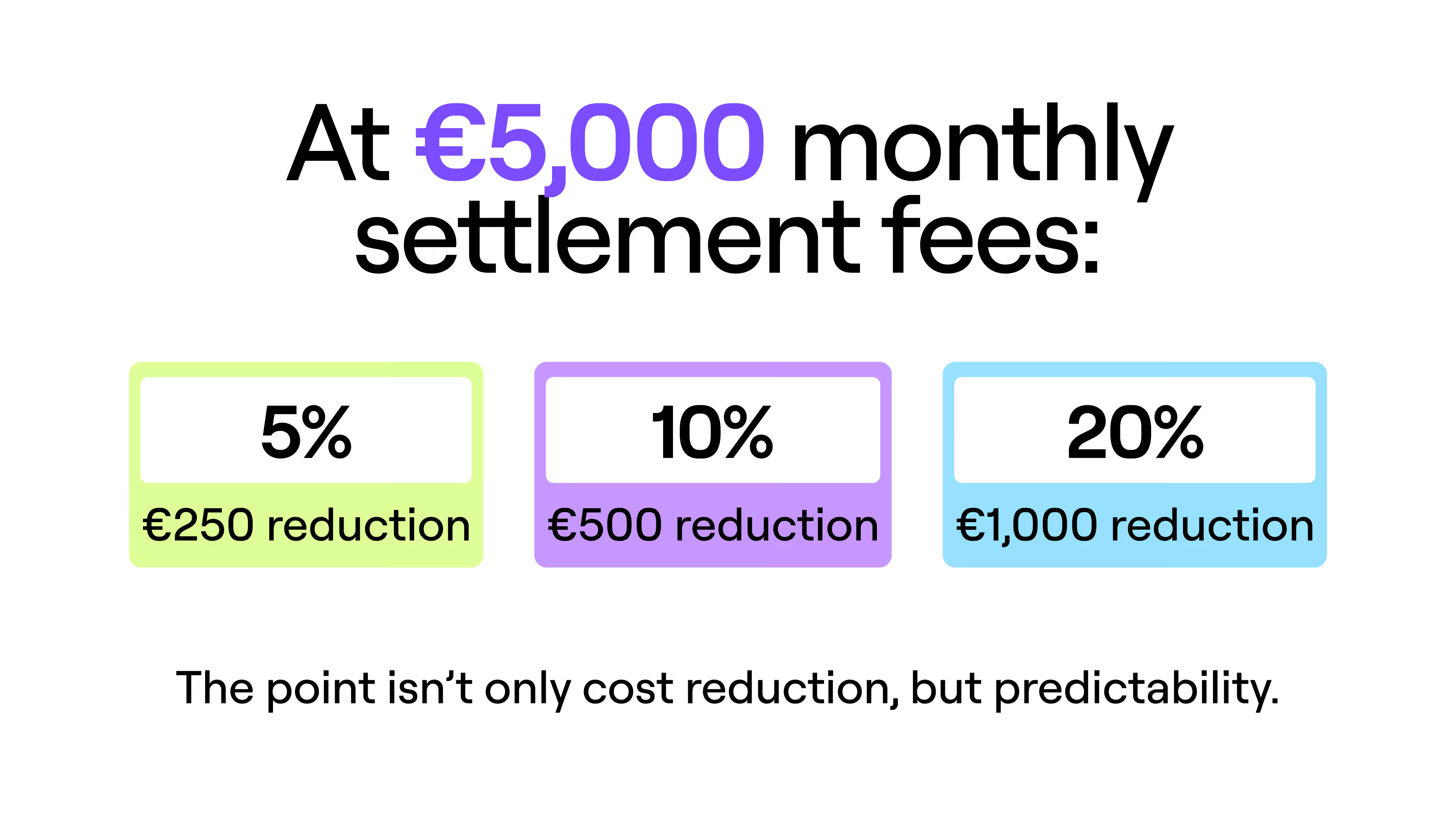
That reduction scales according to the merchant’s staking position:
- 5% discount for merchants staking 100K+ XMN
- 10% discount for 500K+ XMN
- 20% discount for 1.5M+ XMN
The important detail is that these two systems operate independently but simultaneously.
A merchant can earn XMN Rewards from payment volume while also reducing settlement costs through staking.
One mechanism accumulates value.
The other preserves more of it.
How Much Can Merchants Save on Payment Processing Fees?
Merchant Discounts reduce settlement fees automatically based on staking participation.
To make the impact more tangible, consider a merchant processing €50,000, €75,000, or €100,000 per month.
If settlement fees generated total €1,000 monthly:
- 5% Merchant Discount → €50 saved
- 10% Merchant Discount → €100 saved
- 20% Merchant Discount → €200 saved
For businesses processing meaningful payment volume, operational efficiency compounds. Lower settlement costs create stronger margins, better economics, and more flexibility to scale.
Merchant Discounts turn payment infrastructure from a fixed operational expense into something increasingly aligned with business growth.
The Quiet Shift Happening Behind the Dashboard
What makes the system interesting is not necessarily the percentages themselves.
It’s the behavioral shift underneath.
Most loyalty systems are designed around consumption. Spend more, collect points, redeem rewards, repeat.
This model behaves differently because it turns payment infrastructure into something participatory rather than purely transactional.
Merchants are no longer interacting only as users of the network. They gradually become stakeholders inside the same ecosystem processing their payments.
And, importantly, none of this changes the operational experience: no new integration, no manual claiming process, no additional accounting complexity. As it should!
Rewards, staking balances, discount tiers, unlock schedules, and payout visibility are all directly in the merchant dashboard, integrated into the same infrastructure merchants already use daily.
Why Staking Is Measured Over Time
One of the most important structural choices behind Merchant Discounts is how staking tiers are calculated.
Many rewards systems measure balances instantly, which can create short-term optimization behavior. Rather than checking a merchant’s balance at a single moment, xMoney measures participation and calculates discount eligibility using the median staking balance across the previous 30 days.
That design matters.
Without it, staking systems become easy to manipulate through short-term balance movements designed only to unlock temporary benefits.
By measuring sustained participation instead, the system rewards consistency rather than timing.
It also creates more stability for merchants themselves, since temporary fluctuations or short-term wallet movements do not instantly impact their tier.
The objective is to align incentives over time, without creating pressure around staking behavior.
The Future of Payment Infrastructure Is Participation
At a technical level, Merchant Rewards and Merchant Discounts are relatively simple systems.
But strategically, they point toward something much larger.
Historically, payment infrastructure has been designed to optimize movement: faster settlements, better authorization rates, lower fraud, improved compliance.
All important improvements.
But the next evolution of financial infrastructure is not only about how efficiently money moves. It is about whether participation in those systems creates lasting value for the businesses using them.
That’s the layer xMoney is beginning to build.
A payment environment where transaction activity doesn’t simply disappear into operational costs, but gradually feeds back into the ecosystem itself.
Without speculation or complexity, but through infrastructure that quietly changes the economics behind participation.
Want to explore the details? You can find a full breakdown of tiers, rewards, and mechanics in our support FAQs.
Part of a Bigger Initiative
The expansion of xMoney Rewards is part of BLOCKCHAIN.PT, a national initiative co-funded by the Portuguese Republic and the European Union through the Next Generation EU program.
Within that framework, the objective goes beyond introducing blockchain into payments for the sake of innovation alone.
The focus is building financial infrastructure that is more transparent, more aligned, and more economically efficient for the businesses using it every day.
Because the future of payments will not only be defined by how seamlessly transactions happen.
But by what those transactions make possible afterward.
Latest Articles










.webp)
.avif)







.avif)

.avif)
Join 20,000+ businesses already growing
We build and integrate solutions. You grow with xMoney.
