
Modern Wealth Moves: How Luxury, Digital Capital, and Payments Are Converging
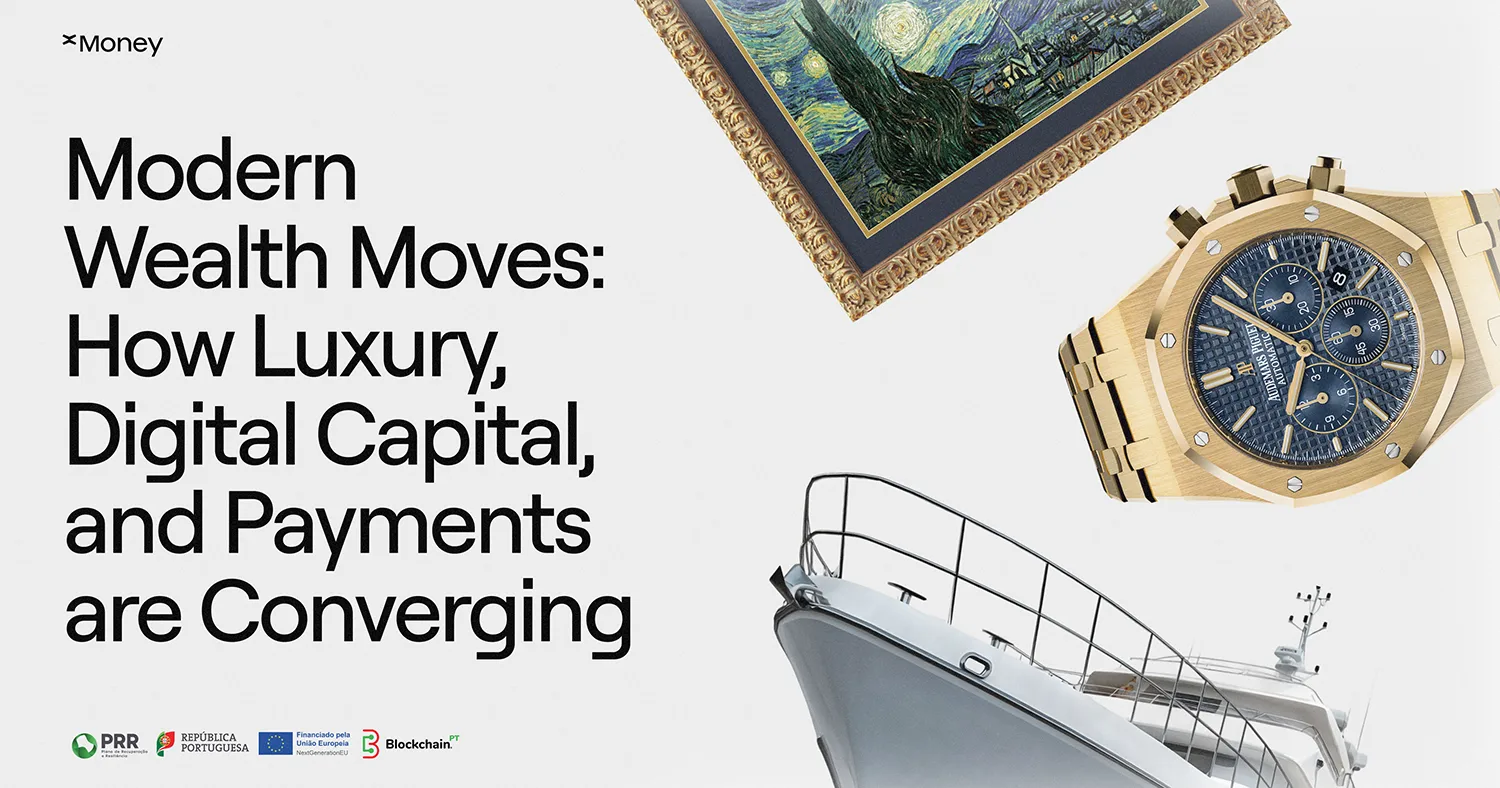
Luxury has never been static. It evolves with culture, taste, and technology. But in 2026, something deeper is shifting beneath the surface of the industry, not in how luxury looks or is defined, but in how it moves.

Across jewelry, watches, supercars, yachts, private aviation, and fine art, a new financial reality is emerging. Wealth is becoming more global, more digital, and more fluid. And yet, the infrastructure behind high-value payments has remained largely unchanged.
This is where the disconnect begins, and where the next evolution of luxury payment services is taking shape.
Luxury Is Expanding While Capital Is Transforming
The global personal luxury goods market is now approaching the $500 billion mark, according to Statista. At the same time, digital assets have surpassed $2 trillion in total market capitalization (CoinMarketCap), increasingly becoming part of diversified portfolios held by high-net-worth individuals (HNWI).
These two forces are no longer separate.
Collectors of rare watches, fine jewelry buyers, luxury car enthusiasts, and ultra-wealthy investors are operating in a financial environment where capital is no longer confined to traditional banking rails. Wealth today is global by default, and increasingly digital in structure.
However, while wealth has evolved, settlement systems have not.
Luxury brands still rely heavily on cross-border banking infrastructure designed for a different era: introducing delays, FX exposure, reconciliation complexity, and operational friction that feels increasingly misaligned with the expectations of modern buyers.
Luxury is about certainty, but… Certainty depends on infrastructure.
When High-Value Payments Stop Behaving Like Payments
A defining characteristic of luxury commerce is that it rarely operates locally. Whether it is a watch in Geneva, a supercar in Milan, or a piece of fine art in London, transactions are typically cross-border, multi-currency, and high-value by nature.
Research from Altrata’s World Ultra Wealth Report highlights that ultra-high-net-worth individuals (UHNW) allocated nearly $129 billion to luxury transportation alone in 2024, spanning supercars, yachts, and private jets. These transactions are large and operationally complex.
So, at this scale, payments stop behaving like simple payment transfers.
They become multi-layered processes involving correspondent banks, compliance checks, FX conversions, liquidity considerations, and reconciliation workflows that often operate independently rather than as a unified system.
The result is predictable: settlement delays, reduced visibility, and operational inefficiencies that slow down transactions where timing and certainty are critical.
At $200, the system feels instant. At $2 million, it reveals its fragmentation.
The Structural Gap Between Luxury and Payments Infrastructure
What defines today’s challenge is not the absence of payment systems, but their lack of integration.
Compliance, settlement, FX, and reconciliation exist as separate layers. Each is functional on its own, but together they create friction. This fragmentation is one of the most persistent issues in cross-border payments, as highlighted by the Bank for International Settlements, which has repeatedly pointed to interoperability as a core limitation in global financial infrastructure.
The consequence is not just operational inefficiency, but a mismatch between expectation and execution.
Luxury clients expect seamlessness. They expect discretion. They expect speed. But behind the scenes, transactions still depend on systems built for a less interconnected financial world.
As digital wealth expands, this gap becomes more visible and more costly.
Capital Meets Precision With Jewelry, Watches, Fine Art, & Other Assets
In the world of fine jewelry and luxury watches, value is both emotional and financial. Transactions often involve international collectors, private buyers, and high-value assets that require speed, certainty, and discretion.
Yet even in this highly curated segment, payment systems often introduce friction at the final step of the experience.
Cross-border wires, FX delays, and manual reconciliation processes remain common, particularly in transactions involving multiple jurisdictions.
This is where modern payment infrastructure begins to matter not as an operational layer, but as part of the luxury experience itself.
With xMoney, luxury merchants can issue invoices in minutes, accept digital asset payments, and settle in their preferred currency — EUR, USD, GBP, or crypto currencies — within a regulated, MiCA-aligned infrastructure.
The result is efficiency. But more than that, it offers alignment between modern capital and timeless assets.
Supercars, Yachts & Private Jets: Speed Must Match Value
Nowhere is the pressure for better payment infrastructure more visible than in high-performance luxury transport.
Supercars, yachts, and private jets represent some of the highest-value discretionary purchases in the global economy. According to Altrata, ultra-wealthy buyers spent nearly $129 billion on luxury transportation in 2024 alone.
But these transactions are rarely straightforward.
They span jurisdictions, currencies, and financial systems. And in many cases, payment speed becomes as important as the asset being purchased.
Delays in settlement can stall delivery, complicate logistics, and disrupt commercial agreements.
xMoney enables a different approach: high-value invoicing in crypto currency, global acceptance, and regulated settlement into the merchant’s preferred currency. This creates a payment solution that matches the global nature of luxury mobility.
When wealth moves across borders, payments should move with it… Not behind it.
Fine Art & Collectibles are Built on Global Movement
The art market has always been international, but today it is also increasingly digital in behavior.
According to The Art Basel and UBS Global Art Market Report 2026, the global art market reached approximately $59.6 billion in 2025. Meanwhile, leading auction houses such as Christie’s and Sotheby’s generated over $13 billion in combined sales in 2025, driven largely by high-value international transactions.
Despite this global scale, the transaction layer remains deeply traditional.
High-value art acquisitions still depend on bank transfers, manual verification processes, and layered compliance checks that can slow down or complicate deals where timing and discretion are essential.
This creates a structural gap between how collectors hold wealth and how they are required to transact it.
xMoney addresses this gap by enabling global invoicing, regulated digital asset acceptance, and settlement in fiat currencies without exposing merchants to volatility or custody risk. Every transaction is fully monitored under AML/KYT frameworks, ensuring compliance while removing operational friction.
The result is a more modern financial layer for a centuries-old market.
A Unified View of Modern Luxury Payments
Across all luxury verticals, from watches to yachts to fine art, the pattern is consistent.
Wealth is becoming more global and digitally distributed. Yet payment infrastructure remains fragmented, layered, and slow at the point where precision matters most.
This is not a failure of the system, but a limitation of its design.
Luxury does not need faster payments alone. It needs connected payments and systems with a unified flow.
That is where the next generation of infrastructure is emerging.
xMoney and the Future of Luxury Transactions
xMoney sits at the intersection of digital assets and regulated financial infrastructure, enabling luxury merchants to operate within both fiat and crypto economies without complexity or compromise.
It is not about replacing existing systems. The goal is connecting them more effectively, so that high-value transactions can move at the speed and certainty that modern wealth demands.
As digital capital becomes embedded in global portfolios, and as luxury continues to expand across borders, the question is no longer whether payments need to evolve.
It is how quickly they can catch up.
Discover how your luxury brand can modernize transactions starting today.
Latest Articles

.webp)

.avif)
.avif)









.avif)
Join 20,000+ businesses already growing
We build and integrate solutions. You grow with xMoney.
