
Why High-Value Payments Still Break in 2026
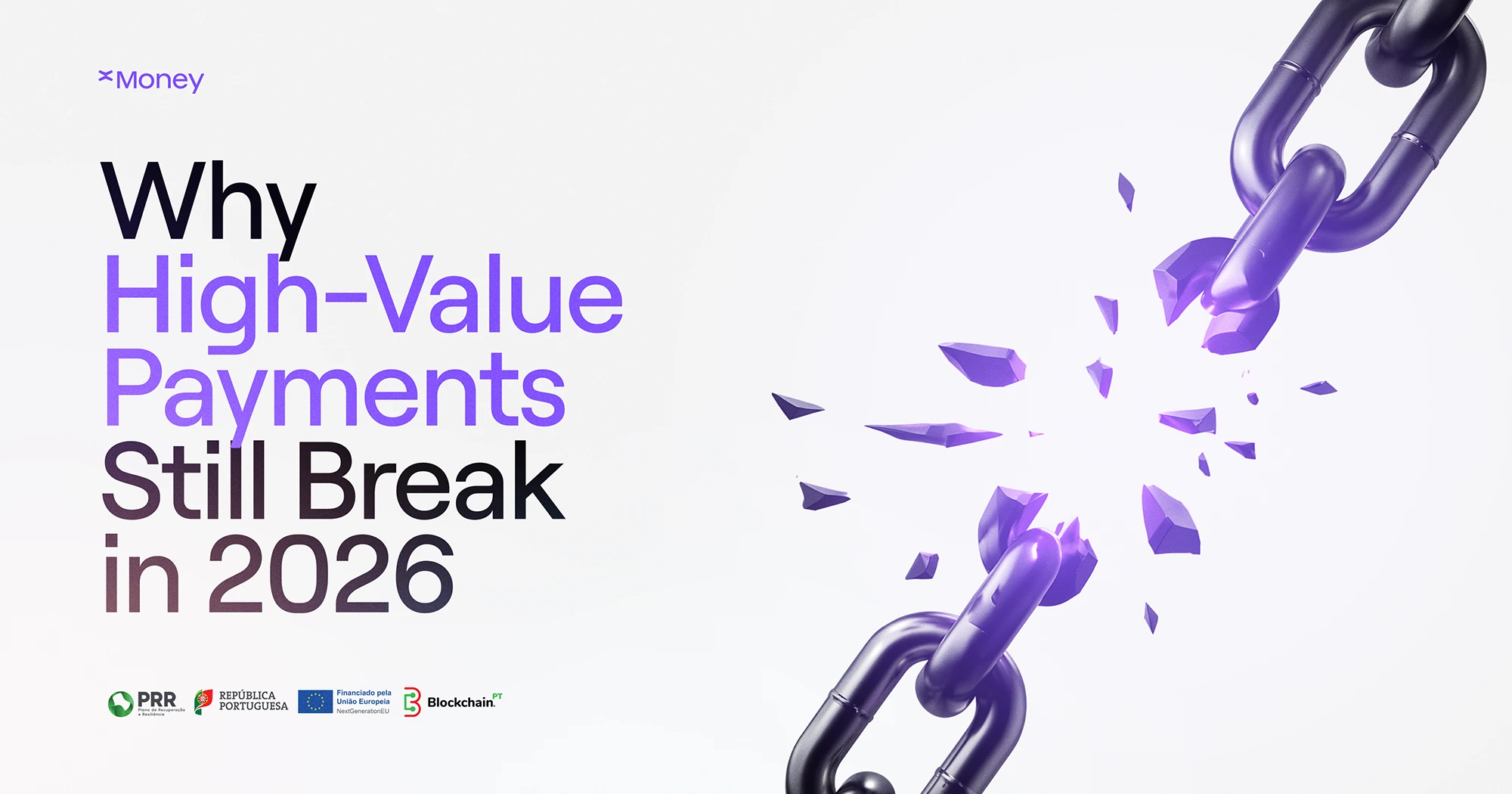
High-value payments aren't just bigger — they're structurally different. Explore why moving €2M across borders remains slow, fragmented, and complex.

The illusion of instant money
Payments feel solved… Until they aren’t.
You can send money across borders in minutes, pay for services without thinking, and move small amounts with almost no friction. It creates a sense that the infrastructure behind money has caught up with the pace of everything else.
But that illusion breaks quickly.
Try moving €2 million across borders. Or closing a high-value transaction between two companies operating in different jurisdictions. What felt instant becomes layered, slower, and far less predictable. Settlement timelines stretch. Visibility drops. Fees start appearing in places you didn’t expect.
This isn’t an exception.
It’s how the system behaves at scale.
Where most of the money actually moves
The reality is that global finance is not driven by everyday payments.
According to the International Monetary Fund, transactions above $1 million account for the vast majority of cross-border payment value, even if they represent a small share of total transaction volume.
In other words, the system that moves the most money is not the one most people experience daily.
And it operates under very different constraints.
Why €2M doesn’t move like €200
High-value payments aren’t just “bigger.” They are structurally different.
They move through a chain of systems that were built independently and layered over time:
- Correspondent banks handling settlement across jurisdictions
- Compliance checks applied at multiple stages
- FX conversions depending on corridor and liquidity
- Internal reconciliation processes that often happen after settlement
Each step exists for a reason. Together, they introduce friction.
Even today, cross-border payments can take several business days to settle, especially when multiple currencies or regulatory frameworks are involved. According to industry analysis, only a small portion of global cross-border payments are processed in real time, with delays and costs remaining persistent challenges.
At lower values, this friction is tolerable.
At €2M, it becomes a constraint.
When delays become business problems
Payment delays are often treated as operational inefficiencies, something to optimize over time.
But in high-value transactions, they directly affect outcomes.
When capital is in transit, it is unavailable. That impacts liquidity, planning, and decision-making. A delayed settlement can slow down an acquisition, postpone inventory movement, or complicate supplier relationships.
Research into cross-border payment flows shows that delays and lack of transparency continue to create measurable inefficiencies for businesses operating internationally.
At this level, payments are no longer just execution.
They become part of the strategy.
The deeper issue: systems that don’t fully connect
It’s tempting to frame this as a cost problem. Or even a speed problem.
It’s neither (at least not primarily).
The real issue is fragmentation.
Payments rely on multiple systems that don’t share a single source of truth. Compliance, settlement, FX, and reconciliation operate in parallel rather than as a unified process. That’s why visibility is limited and why improvements often feel incremental instead of transformative.
The Bank for International Settlements has repeatedly pointed to fragmentation and limited interoperability as core reasons why cross-border payments remain slow and opaque.
The system works.
Just not as a cohesive one.
Expectations have already moved ahead
While infrastructure evolves gradually, expectations don’t.
Businesses now operate globally by default. Transactions are expected to be continuous, not limited by banking hours. Buyers and partners assume speed and clarity as standard.
This creates a growing disconnect.
The experience of moving €200 has improved dramatically over the past decade. The experience of moving €2M has improved - but not at the same pace.
And that gap is where friction becomes visible.
Where blockchain enters the conversation
This is often the point where blockchain is introduced as a way to remove intermediaries and accelerate settlement.
And in certain contexts, it does exactly that.
But high-value payments don’t exist in isolation. They are tied to regulatory frameworks, business obligations, and financial controls that extend beyond the transaction itself.
Speed alone is not enough.
Infrastructure needs to support:
- Compliance requirements across jurisdictions
- Integration with fiat systems and banking rails
- Predictability and auditability for businesses
Without that, improvements in one layer simply shift complexity elsewhere.
xMoney x Blockchain Agenda: Building for how money actually moves
xMoney’s approach starts from the constraints, not the technology.
The goal is not to replace existing systems, but to connect them more effectively, using blockchain where it improves settlement and transparency, while maintaining compatibility with fiat infrastructure and regulatory requirements.
And we’re not doing it alone.
Blockchain Agenda is a program with European incentives that includes several Portuguese national stakeholders, targeting innovation in secure, efficient, and scalable blockchain-based payment solutions. And xMoney is one of the institutions working under its scope of incentives, developing specific projects.
The goal? A practical approach to modernizing payments:
- Not by removing structure
- But by redesigning how systems interact
Because in high-value transactions, reliability is what enables speed, and not the other way around.
What changes next
High-value payments are where inefficiencies are most expensive, and where improvements have the greatest impact.
As cross-border commerce grows and digital assets become more integrated into financial systems, the pressure on payment infrastructure will continue to increase.
The next phase won’t be defined by entirely new ideas.
It will be defined by how well those ideas are implemented within real-world constraints — across regulation, liquidity, and system design.
At scale, payments define more than movement
They define timing.
They define trust.
And in many cases, they define whether a transaction happens at all.
Latest Articles
.webp)
.avif)
.avif)

.avif)


Join 20,000+ businesses already growing
We build and integrate solutions. You grow with xMoney.
